

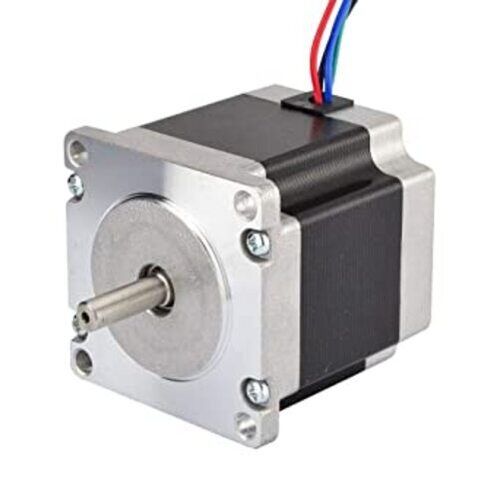

Precision and Versatility for Industrial Automation
Equipped with a 1.8 step angle and holding torque of 4.2 kg-cm, this hybrid stepper motor excels in applications demanding precise movement and sturdy performance. Its two-phase design and four-lead wiring simplify integration into a wide range of control systems for robotics, 3D printing, and CNC machinery.
Durable Construction and Easy Installation
The motor features a strong 42 x 42 mm (NEMA 17) frame size with a 5 mm shaft and mounting holes for hassle-free setup. Designed for industrial environments, its insulation class B guarantees safety and reliability, even under varying temperature conditions. Its compact weight of 400 g offers both strength and flexibility.
FAQ's of Hybrid Stepper Motor:
Q: How do I wire the hybrid stepper motor for proper operation?
A: This stepper motor uses 4 lead wires and operates with 2 phases. Connect each pair of wires to the appropriate phase output on your stepper driver as per the wiring diagram provided with your controller.Q: What applications are ideal for this hybrid stepper motor?
A: Thanks to its high precision and robust torque, this motor is perfect for CNC, 3D printers, robotics, and automation systems requiring reliable rotary motion and accurate step control.Q: When should I use a hybrid stepper motor over a standard one?
A: Choose a hybrid stepper motor when you need increased step accuracy (5%) and higher holding torque, particularly in applications where smooth, reliable motion and positional precision are essential.Q: Where can I purchase or source this stepper motor in India?
A: We manufacture and supply this hybrid stepper motor directly from India, catering to exporters, manufacturers, and local suppliers. Contact our sales team or authorized distributors for purchasing information.Q: What is the process for mounting and installing this motor?
A: Mounting is straightforward with the NEMA 17 (42 x 42 mm) frame and 3.5 mm diameter mounting holes. Secure the motor to your apparatus using compatible screws and ensure proper alignment of the 5 mm shaft.Q: How does the insulation resistance benefit the application?
A: With insulation resistance greater than 100 M at 500 VDC and Class B insulation, the motor is protected against electrical leakage and breakdown, ensuring long-term operational safety and reliability in demanding environments.Q: What are the usage limitations related to temperature for this motor?
A: The motor operates reliably between -20C and 50C and can be stored from -30C to 70C. For optimal performance and safety, operate it within the recommended temperature range.Hybrid Stepper Motor
Product Details:
- Resistance 1.0 (per phase)
- Output Rotary Motion
- Theory Electromagnetic Induction
- Type Hybrid Stepper Motor
- Accuracy 5% (typical)
- Operating Voltage 2.8 VDC
- Output Voltage Not Applicable (driven by current)
- Click to View more
Hybrid Stepper Motor Price
- 1850 INR/Number
- 1 Number
Hybrid Stepper Motor Specification
- Rotary Motion
- -30C to 70C
- Electromagnetic Induction
- 2.8 VDC
- -20C to 50C
- 5% (typical)
- Not Applicable (driven by current)
- 0C to 50C
- Hybrid Stepper Motor
- 1.0 (per phase)
- 2.0 A
- 3.5 mm
- >100 M at 500 VDC
- 42 x 42 mm (NEMA 17)
- Class B
- 400 g
- 4 Leads
- 5% (no load)
- 5 mm
- 4.2 kg-cm
- 2 Phases
- 1.8 per step
Product Description
A hybrid stepper motor, frequently alluded to as a "hybrid stepper," is a kind of stepper motor that consolidates highlights of both super durable magnet (PM) and variable hesitance (VR) stepper motors. Hybrid stepper motors are intended to offer the benefits of the two kinds while limiting their downsides. They are broadly utilized in different applications, including CNC apparatus, 3D printers, mechanical technology, and mechanized frameworks requiring exact movement control.
FAQs of Hybrid Stepper Motor:
Q: How does a hybrid stepper motor work?
A: Hybrid stepper motors work in view of the standards of electromagnetic fields, like other stepper motor sorts. They have a rotor (the moving part) and stator (the fixed part). The rotor regularly has teeth or shafts with long-lasting magnets, while the stator contains loops of wire. By empowering the curls in a particular grouping, a pivoting attractive field is made, which collaborates with the rotor's extremely durable magnets, making the rotor move in discrete advances.
Q: How are hybrid stepper motors controlled?
A: Hybrid stepper motors are controlled utilizing particular electronic drivers or regulators, very much like other stepper motors. These regulators send a grouping of electrical heartbeats to the motor windings, deciding the heading and distance of each step. The arrangement can be full-venturing or microstepping, and the speed and course of turn can be constrained by changing the beat recurrence and extremity.
Q: How would you choose the right hybrid stepper motor for an application?
A: Choosing the right hybrid stepper motor includes considering factors like the necessary force, speed, step point, and actual size of the motor. Matching the motor's determinations to the particular requirements of the application is fundamental for ideal execution. Furthermore, the decision of stepper driver or regulator ought to be viable with the motor and application prerequisites.
Technical Details
Precision and Versatility for Industrial Automation
Equipped with a 1.8 step angle and holding torque of 4.2 kg-cm, this hybrid stepper motor excels in applications demanding precise movement and sturdy performance. Its two-phase design and four-lead wiring simplify integration into a wide range of control systems for robotics, 3D printing, and CNC machinery.
Durable Construction and Easy Installation
The motor features a strong 42 x 42 mm (NEMA 17) frame size with a 5 mm shaft and mounting holes for hassle-free setup. Designed for industrial environments, its insulation class B guarantees safety and reliability, even under varying temperature conditions. Its compact weight of 400 g offers both strength and flexibility.
FAQ's of Hybrid Stepper Motor:
Q: How do I wire the hybrid stepper motor for proper operation?
A: This stepper motor uses 4 lead wires and operates with 2 phases. Connect each pair of wires to the appropriate phase output on your stepper driver as per the wiring diagram provided with your controller.Q: What applications are ideal for this hybrid stepper motor?
A: Thanks to its high precision and robust torque, this motor is perfect for CNC, 3D printers, robotics, and automation systems requiring reliable rotary motion and accurate step control.Q: When should I use a hybrid stepper motor over a standard one?
A: Choose a hybrid stepper motor when you need increased step accuracy (5%) and higher holding torque, particularly in applications where smooth, reliable motion and positional precision are essential.Q: Where can I purchase or source this stepper motor in India?
A: We manufacture and supply this hybrid stepper motor directly from India, catering to exporters, manufacturers, and local suppliers. Contact our sales team or authorized distributors for purchasing information.Q: What is the process for mounting and installing this motor?
A: Mounting is straightforward with the NEMA 17 (42 x 42 mm) frame and 3.5 mm diameter mounting holes. Secure the motor to your apparatus using compatible screws and ensure proper alignment of the 5 mm shaft.Q: How does the insulation resistance benefit the application?
A: With insulation resistance greater than 100 M at 500 VDC and Class B insulation, the motor is protected against electrical leakage and breakdown, ensuring long-term operational safety and reliability in demanding environments.Q: What are the usage limitations related to temperature for this motor?
A: The motor operates reliably between -20C and 50C and can be stored from -30C to 70C. For optimal performance and safety, operate it within the recommended temperature range.
Price:
- 50
- 100
- 200
- 250
- 500
- 1000+

Other Products in 'Stepper Motors' category

- Motion Control Instruments
- Digital Instruments
- Electronic SMPS
- Shaft Encoder
- Spiral Couplings
- Proximity Sensors
- Safety Light Curtains
- Static Eliminators
- Miniature DC Motors
- Stepper Motors
- BLDC Motors
- AC And DC Motors
- AC Tachogenerators
- DC Tachogenerators
- Radio Energie
- Industrial Electrode
- Elevator Automation
- Door Detector
- Elevator Encoders
- Elevator Panels
- Overload Sensors
- Elevator Accesories

GST : 27ALEPK5004H2ZD

- 213 to 217, Damji Shamji Industrial Complex, LBS Marg, Kurla West,Mumbai - 400070, Maharashtra, India
- Phone :08071793191

- Mr Kedar Dilip Kothari (C.E.O.)
- Mobile :08071793191
- Send Inquiry
 Send Inquiry
 Send Inquiry
 Call Me Free
Developed and Managed by Infocom Network Private Limited.

